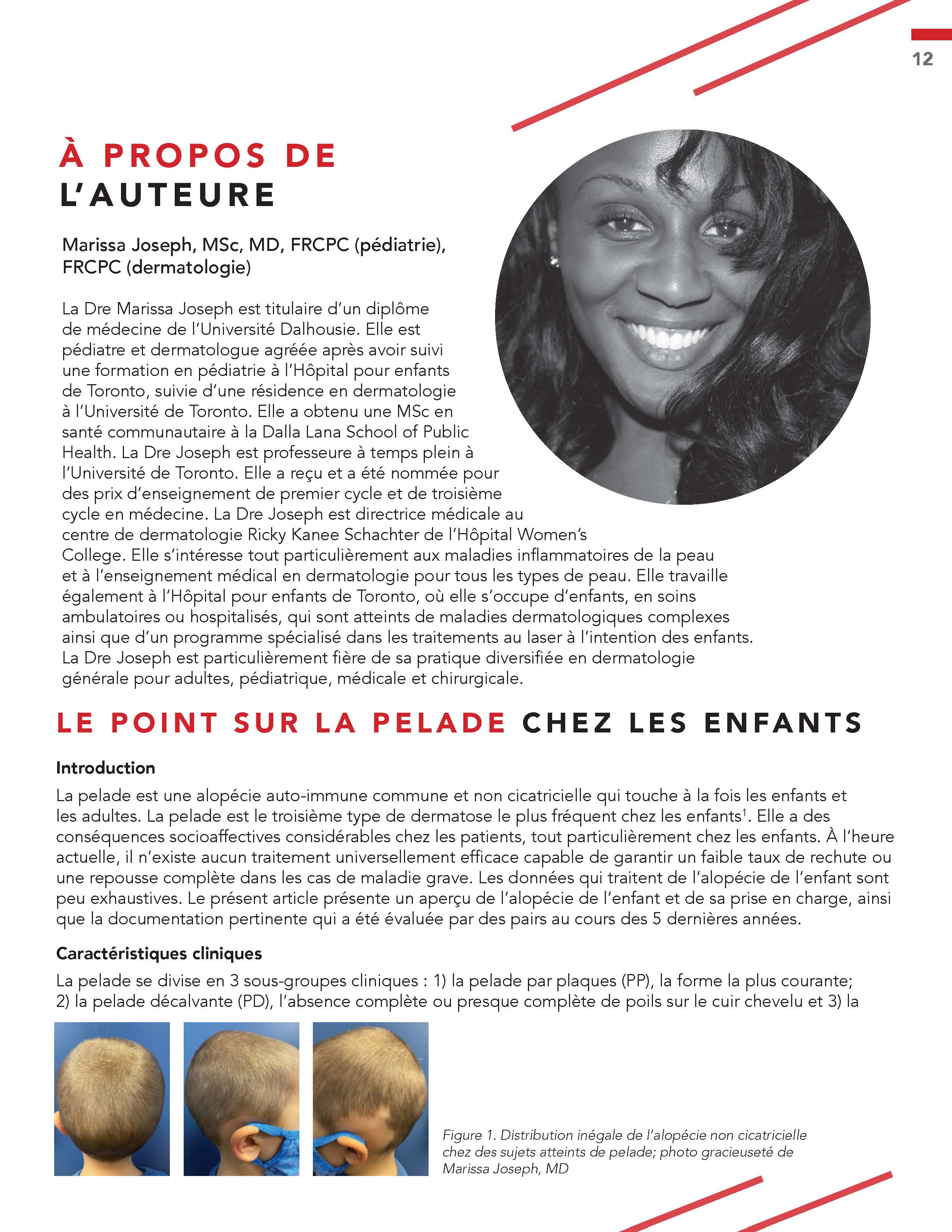
Le point sur la pelade chez les enfants
Résumé
La pelade est une alopécie auto-immune commune et non cicatricielle qui touche à la fois les enfants et les adultes. La pelade est le troisième type de dermatose le plus fréquent chez les enfants. Elle a des conséquences socioaffectives considérables chez les patients, tout particulièrement chez les enfants. À l’heure actuelle, il n’existe aucun traitement universellement efficace capable de garantir un faible taux de rechute ou une repousse complète dans les cas de maladie grave. Les données qui traitent de l’alopécie de l’enfant sont peu exhaustives. Le présent article présente un aperçu de l’alopécie de l’enfant et de sa prise en charge, ainsi que la documentation pertinente qui a été évaluée par des pairs au cours des 5 dernières années.
Références
Wohlmuth-Wieser, Iris, et al. “Childhood alopecia areata—data from the National Alopecia Areata Registry.” Pediatric Dermatology. 2018 Mar;35(2):164-169. doi: 10.1111/pde.13387. Epub 2018 Jan 15.
Juárez-Rendón, Karina J., et al. “Alopecia areata: Actualidad y perspectivas.” Archivos argentinos de pediatria. 2017;115(6):e404-e411.
Patel D, Li P, Bauer AJ, Castelo-Soccio L. Screening guidelines for thyroid function in children with alopecia areata. JAMA Dermatol. 2017;153(12):1307-1310.
Mahmoudi H, Salehi M, Moghadas S, Ghandi N, Teimourpour A, Daneshpazhooh M. Dermoscopic findings in 126 patients with alopecia areata: A cross-sectional study. Int J Trichology. 2018;10(3):118-123.
Donovan J. Donovan medical trichoscopy. https://donovanmedical.com/trichoscopy.
Burnat AW, et al. “Trichoscopy of alopecia areata in children. A retrospective comparative analysis of 50 children and 50 adults.” Pediatric Dermatology. 2019;36(5):640-645.
Liu, Lucy Y, et al. “Tofacitinib for the treatment of severe alopecia areata and variants: a study of 90 patients.” Journal of the American Academy of Dermatology. 2017;76(1):22-28.
Nawaf A, Nour TM, Hussain NH. “Janus kinase inhibitors for the treatment of severe alopecia areata: an open-label comparative study.” Dermatology. 235(2):130-136.
Phan K, Sebaratnam DF. “JAK inhibitors for alopecia areata: a systematic review and meta-analysis.” Journal of the European Academy of Dermatology and Venereology. 2019 May;33(5):850-856.
Liu LY, King BA, Craiglow BG. “Alopecia areata is associated with impaired health-related quality of life: a survey of affected adults and children and their families.” Journal of the American Academy of Dermatology. 2018 Sep;79(3):556-558.e1. doi: 10.1016/j.jaad.2018.01.048.
Theresa C, Yang JS, Soccio LC. “Bullying and quality of life in pediatric alopecia areata.” Skin appendage disorders. 2017;3(3):115-118.
Canadian alopecia areata foundation. https://www.canaaf.org/
Messenger AG, et al. “British Association of Dermatologists’ guidelines for the management of alopecia areata 2012.” British journal of dermatology. 2012;166(5):916-926.
Peloquin L, Soccio LC. “Alopecia areata: an update on treatment options for children.” Pediatric Drugs. 2017 Oct;19(5):411-422. doi: 10.1007/s40272-017-0239-z.
Lemes LR, et al. “Topical and oral minoxidil for hair disorders in pediatric patients: What do we know so far?.” Dermatologic Therapy. 2020 Nov;33(6):e13950. doi: 10.1111/dth.13950. Epub 2020 Jul 14.
Putterman E, Soccio LC. “Topical 2% tofacitinib for children with alopecia areata, alopecia totalis, and alopecia universalis.” Journal of the American Academy of Dermatology. 2018 Jun;78(6):1207-1209.e1. doi: 10.1016/j.jaad.2018.02.031.
Craiglow BG, King BA. Tofacitinib for the treatment of alopecia areata in preadolescent children. Journal of the American Academy of Dermatology. 2019;80(2):568-570.
Li AW, Antaya RJ. “Successful treatment of pediatric alopecia areata of the scalp using topical bimatoprost.” Pediatric dermatology. 2016 Sep;33(5):e282-3. doi: 10.1111/pde.12920.
Lai VWY, et al. “Systemic treatments for alopecia areata: A systematic review.” Australasian Journal of Dermatology. 2019 Feb;60(1):e1-e13. doi: 10.1111/ajd.12913. Epub 2018 Sep 6.
Y Duri, Silverberg NB, Stein SL. “Alopecia areata treated with hydroxychloroquine: A retrospective study of nine pediatric cases.” Pediatric Dermatology. 2018 May;35(3):361-365. doi: 10.1111/pde.13451. Epub 2018 Mar 25.
Joanna N, et al. “Cyclosporine With and Without Systemic Corticosteroids in Treatment of Alopecia Areata: A Systematic Review.” Dermatology and Therapy. 2020;1-13.
Landis ET, Pichardo-Geisinger RO. “Methotrexate for the treatment of pediatric alopecia areata.” Journal of Dermatological Treatment. 2018;29(2):145–148.
Liu LY, King BA. “Tofacitinib for the treatment of severe alopecia areata in adults and adolescents.” Journal of Investigative Dermatology Symposium Proceedings. 2018 Jan;19(1):S18-S20.
Craiglow BG, Liu LY, King BA. “Tofacitinib for the treatment of alopecia areata and variants in adolescents.” Journal of the American Academy of Dermatology. 2017 Dec 28;17(1):78.